Portland's food culture is built on independent operators, food cart pods that have evolved into brick-and-mortar restaurants in Kerns and Division Street, craft breweries occupying converted warehouses in the Pearl District and North Williams corridor, and neighborhood taprooms that anchor blocks in Alberta Arts and Mississippi Avenue. Nearly every one of these buildings carries a flat or low-slope roof in a city that receives roughly 36 inches of rain annually, much of it arriving as persistent drizzle across the October-through-May stretch that gives Portland its perpetually gray reputation.
The steady, low-intensity rainfall that characterizes Portland winters is in some ways more damaging to commercial roofs than the intense storm events common in other markets. Water that sits on a membrane surface for days at a time rather than draining quickly after a downpour finds every micro-defect, a seam slightly lifted by a summer's thermal cycling, a pipe boot collar that has compressed over time, a drain that is partially blocked by leaf debris from the street trees that line Division and Hawthorne. Restaurant operators who are not inspecting their roofs before the October rainy season begins are setting up their kitchens for a leak discovery in the middle of November service.
Kitchen ventilation in Portland food service buildings faces a specific moisture challenge: the cooking vapor exhaust meets very cold, humid outside air at the rooftop discharge point for much of the year. This promotes aggressive condensation on exhaust stack housings and the membrane immediately surrounding them. Grease-laden condensate accumulates on flashings and creates a surface that holds moisture against the curb base. PVC membrane is frequently preferred over TPO at exhaust locations in Portland because its formulation resists the plasticizer leaching that can occur when grease-loaded condensate contacts TPO membrane over extended periods.
Portland's building stock includes a significant number of older masonry restaurant buildings, converted storefronts in Sellwood, former neighborhood grocery buildings in St. Johns, and early twentieth-century commercial rows in the Lloyd District, where the parapet wall condition is as important to roofing performance as the membrane itself. Water that migrates through deteriorating brick mortar above the roof line bypasses the membrane entirely and enters the building through wall cavities. Any commercial roofing assessment on a Portland masonry restaurant building should include a parapet and coping inspection before membrane repair recommendations are finalized.
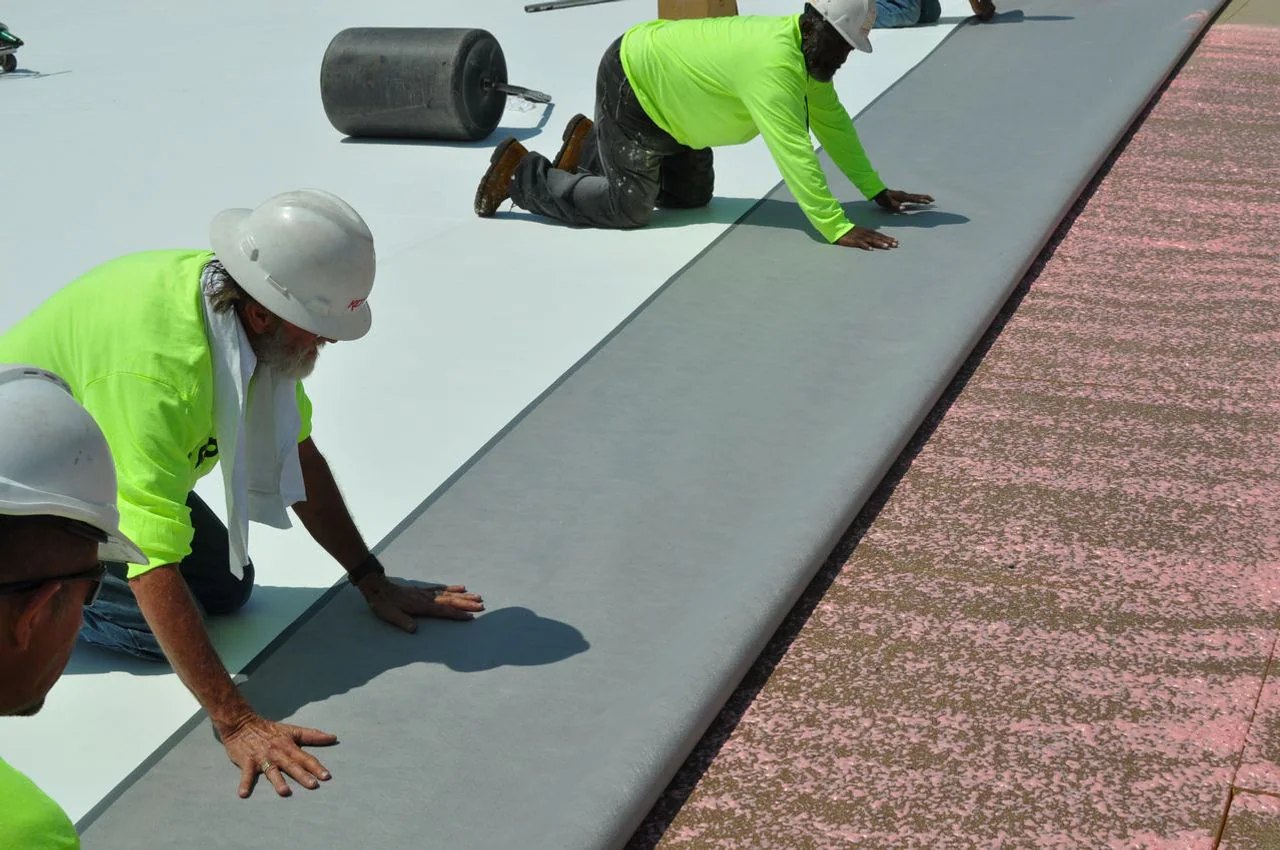
TPO membranes perform reliably on Portland restaurant roofs when properly installed with attention to the region's drainage demands. Portland's flat commercial roofs require positive drainage, minimum quarter-inch per foot slope, to prevent the ponding that leads to accelerated membrane aging and substrate saturation. Restaurants that have grown through additions or equipment upgrades may have inadvertently created low spots that defeat original drainage design. Tapered insulation crickets installed during a re-roofing project can correct these conditions without requiring structural changes to the deck.
Walk-in coolers in Portland restaurants operate in an environment where the ambient humidity outside is high for months at a stretch. This reduces the severity of the condensation differential that plagues desert-market walk-in installations, but it introduces a different problem: the membrane and insulation around walk-in roof curbs must be vapor-managed carefully to prevent the persistent outdoor humidity from slowly wicking into the cooler assembly from the outside. Portland contractors specify closed-cell spray foam at walk-in curb transitions more frequently than contractors in drier markets, using its vapor impermeability to protect the assembly from exterior moisture drive.
Brewery and taproom roofing in Portland involves some of the most complex penetration work in the commercial food service sector. The city's craft brewing community, concentrated in neighborhoods like the Pearl, Slabtown, and along the Central Eastside industrial corridor, operates buildings with fermentation tank pressure relief vents, glycol chiller lines, grain delivery auger penetrations, and extensive OR2 systems all requiring watertight roof penetrations. Many of these breweries occupy buildings that were originally warehouses or manufacturing spaces with built-up roofing systems that have been modified multiple times. A systematic core-cut survey across the roof field is essential before any re-roofing scope is finalized.
Portland's restaurant operators benefit from the city's relatively mild temperatures, hard freezes are infrequent compared to Midwest or Northeast markets, but freeze-thaw events that do occur in late December or January can damage membrane flashings that were borderline before the cold arrived. The annual inspection rhythm for Portland food service buildings should prioritize the rainy season preparation window in September and October, when drains can be cleared, seams checked, and any flashings in deteriorating condition sealed before rainfall accumulation begins. Emergency repairs during February rain events are exponentially more expensive than the preventive work skipped the previous fall.